AI-Powered Feature
AI-Assisted Screening for Systematic Reviews
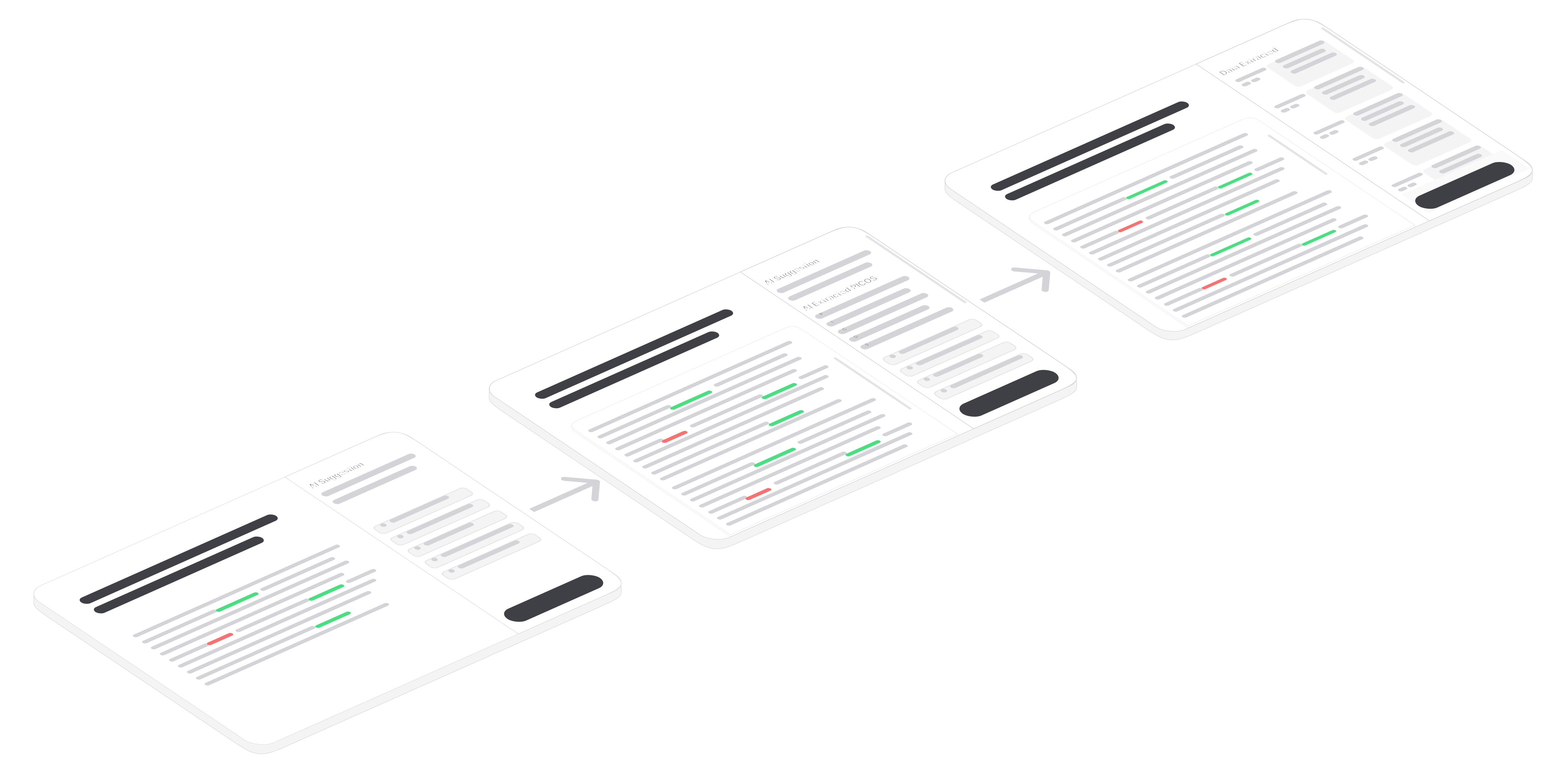
Screen thousands of studies with AI that suggests decisions, provides rationales, and links to source text. You stay in control of every inclusion and exclusion.
Comparative Effectiveness of GLP-1 Receptor Agonists vs DPP-4 Inhibitors in Type 2 Diabetes: A Systematic Review and Meta-Analysis
Martinez R, Chen L, Okafor K · Diabetes Care (2024)
Abstract
Background: This systematic review compared the clinical effectiveness of GLP-1 receptor agonists with DPP-4 inhibitors in adults with type 2 diabetes mellitus.
Methods: Thirty-four randomised controlled trials (n=28,042) were included. Eligible studies enrolled adults with type 2 diabetes receiving GLP-1 agonists or DPP-4 inhibitors for ≥12 weeks.
Results: GLP-1 agonists demonstrated superior HbA1c reduction (−0.4%, 95% CI −0.5 to −0.3) and significant weight loss compared with DPP-4 inhibitors.
Include
Relevant
Rationale
Study compares two pharmacological interventions for T2D management with clinical outcomes. Meets population, intervention, and outcome criteria per protocol.
PICOS Extraction
Adults with Type 2 Diabetes
GLP-1 receptor agonists
DPP-4 inhibitors
HbA1c, cardiovascular events
Randomized controlled trial
The Screening Bottleneck
Screening is the most time-consuming step in any systematic review. With thousands of titles and abstracts to evaluate and hundreds of full texts to review, manual screening creates delays and inconsistencies across reviewers.
Teams need a way to accelerate screening without compromising rigour, and without handing over control to a black box.
Configurable AI
Your Review, Your Level of AI Involvement
Every project can be configured with the level of AI involvement that matches your review type, organisational policy, and comfort level.
No AI
All screening and decisions performed by human reviewers
Standard manual workflows
AI as Assistant
AI suggests decisions with rationales; humans make final decisions
Recommended default for high-risk or novel topics
AI as One Reviewer
AI acts alongside a human reviewer; human conflict resolver adjudicates
Standard SLR with AI acceleration
AI as Only Reviewer
AI performs screening independently with human QC
Rapid triage or targeted landscaping
Separately, projects can require single or dual reviewer workflows. Dual reviewer workflows support two humans or one human and one AI, with blinded decisions and human conflict resolution.
Workflow
How It Works
Upload & De-duplicate
Import references from databases. AI-assisted de-duplication identifies and removes duplicate studies.
Title & Abstract Screening
AI processes each title and abstract against your protocol criteria. In Assistant mode, it shows suggestions with rationales. In Reviewer mode, it screens alongside a human reviewer.
Full-Text Screening with PICOS
AI reads full PDFs using retrieval-augmented generation (RAG), extracting Population, Intervention, Comparator, Outcome, and Study design elements.
Conflict Resolution & QC
Disagreements between reviewers (human or AI) are surfaced for a human conflict resolver. QC mode allows project owners to sample, review, and override any decision.
Trust & Governance
Human Oversight at Every Step
QC Mode
Project owners can sample, review, and override any decision, whether human or AI
Audit Trails
All decisions are recorded with clear identification of which reviewer (human or AI) made each decision
Credit Limits
Organisation administrators can set AI usage limits at organisation and project levels, restricting AI to approved projects or stages
Design principle: AI outputs are suggestions, not final answers. Humans remain responsible for protocols, final decisions, and interpretation.
Validation
Published Results
| Study | Venue | Key Findings |
|---|---|---|
| Radotra et al | ISPOR 2025, Montreal | Replicated five published SLRs; AI recall ranged from 73% to 100% |
| Rathi et al | ISPOR 2024, Atlanta | LLM-assisted full text screening matched human decisions with oversight for complex eligibility |
| Rathi et al | Global Evidence Summit 2024 | High recall with human-in-the-loop configuration |
| Povsic M & Armitage EL | World EPA Congress 2025 | Independent evaluation: ~40% time reduction in a complex breast cancer review |
Related Features
Automated Data Extraction
Extract key data from studies with AI, linked to highlighted sources for verification.
Learn moreAll Features
See the complete platform: workflows, analytics, collaboration, and more.
Learn moreSystematic Review Software
Complete overview of EasySLR as AI-powered systematic review software.
Learn more
Claim your
free project now
No credit card required