Living Review Screening and Evidence Update Summaries
Living Review now offers summaries that explain what each update found and what it means for your review. When extracted evidence is unavailable, the summary covers screening activity, recorded decisions and outstanding work. When new extracted evidence is available, it compares the findings with an earlier project report to show whether they support, extend or change your previous conclusions.
Each summary generation costs 500 AI credits.
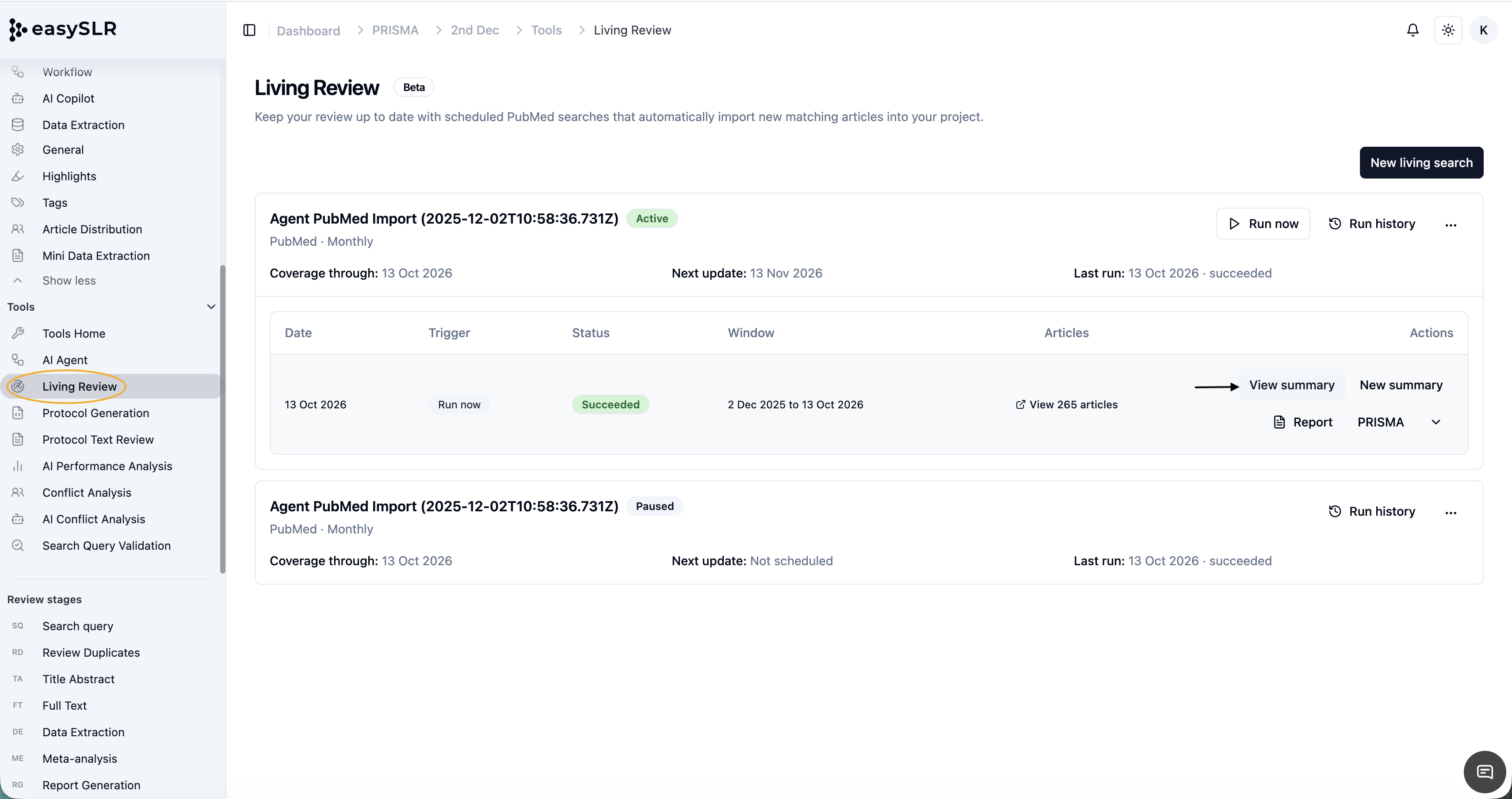
Access and downloads
Successful Living Review runs with unique articles now offers detailed Summary.
Open summaries from Living Review or Report history.
Download summary as a Word document.
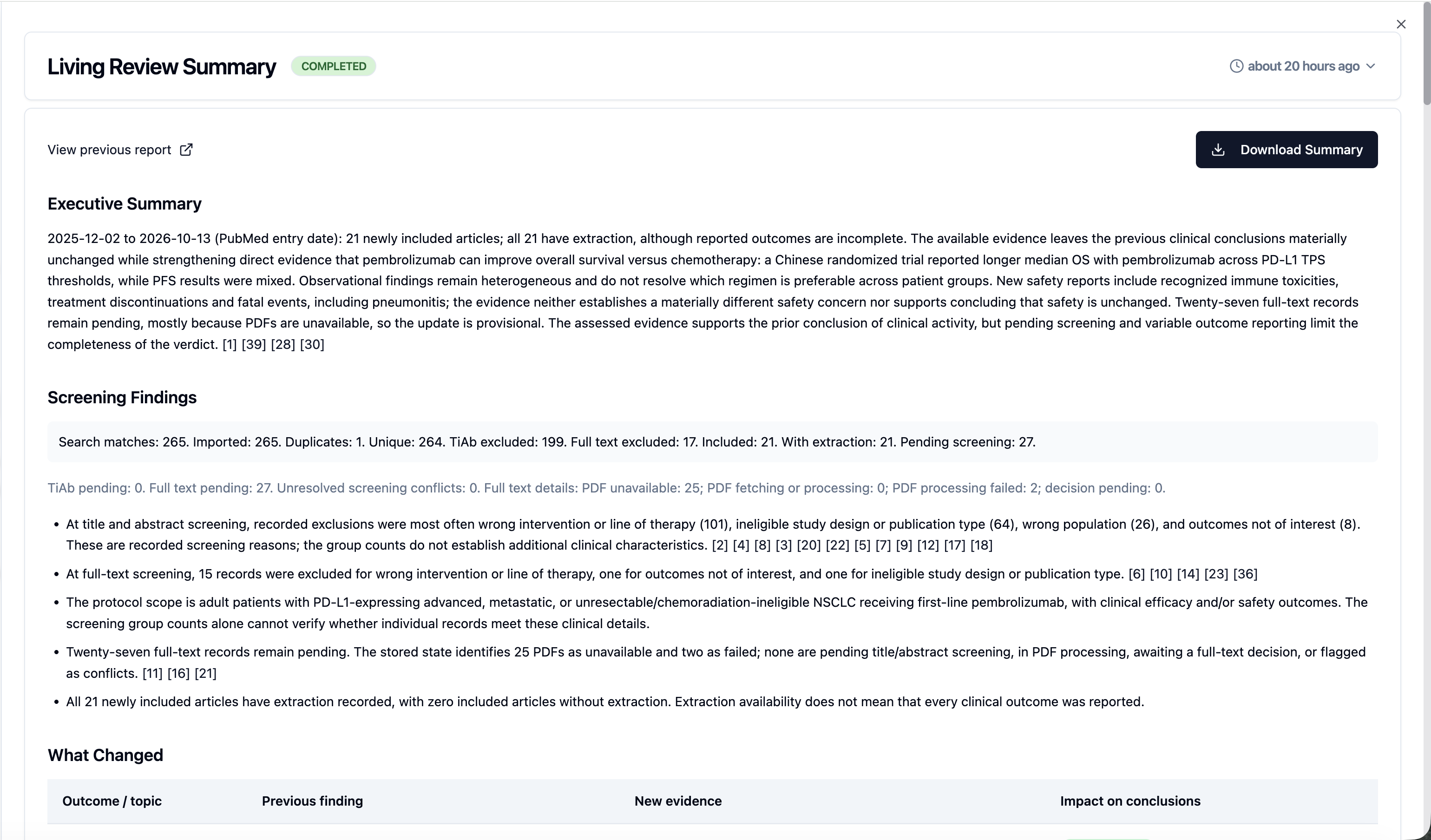
Clearer screening summaries
Summaries explain screening outcomes using the decisions and reasons recorded during the review.
Outstanding work appears in Screening Findings.
The Executive Summary explains how work affects the overall conclusion.
Comparison with an earlier report
Evidence updates compare new findings against a completed report from the same project. The earlier report must cover the whole project and have been completed before the Living Review update began.
Previous findings use the earlier report’s Executive Summary, Introduction and Results.
Supporting numbers are included where available.
Missing estimates are stated explicitly.
Only finally included articles with usable extracted evidence contribute to the evidence comparison.
Other screening outcomes are covered in the screening overview.
Evidence comparisons continue to flag limitations caused by differences between the current and earlier review protocols.
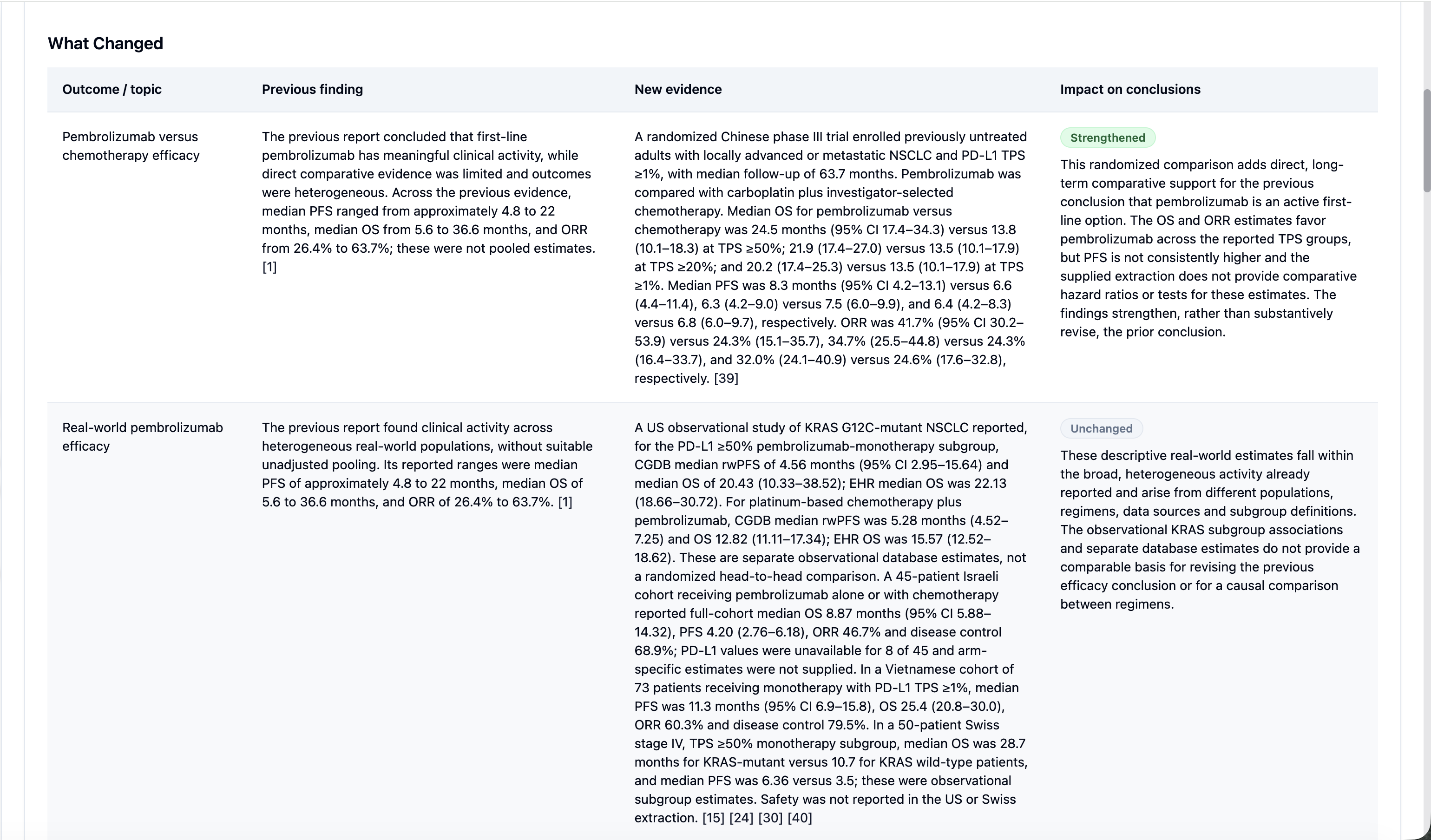
A clear table
The summary and Word download use the same four columns:
Column | What it tells you |
Outcome / topic | The question or finding being reviewed. |
Previous finding | What the earlier report concluded. |
New evidence | What the newly included studies found. |
Impact on conclusions | How previous findings are impacted |
Topic headings stay short. Details about the study population, treatments, comparison groups and follow-up periods appear alongside the evidence. Each impact assessment includes a clear explanation without repeating it in the new-evidence column.
More meaningful evidence summaries
Related studies are discussed together around the previous conclusion, making the update easier to follow.
Every included article with usable extracted evidence contributes to the assessment.
The number of comparison rows follows the evidence, with no fixed row limit.
Reporting gaps are explained alongside the findings they affect.
Results preserve the correct treatment groups, uncertainty ranges, units and measurement timepoints.
Summaries distinguish between results that were not reported and results that do not support a clear conclusion.
The detailed findings and overall conclusion are kept consistent.
A numerical difference or statistically significant result alone is not treated as proof of a meaningful change.
Clearer citations and references
Previous findings cite sources from the earlier report; new findings cite the newly included articles.
Numbered citations link to a shared References section in the summary and Word download.
New article references use a consistent format, including authors, title, journal, publication details and DOI.